

South Africa has taken a decisive and commendable step by moving to ratify the AfCFTA Protocol on Women and Youth in Trade, converting a continental commitment into domestic law and demonstrating that political will can follow words. The Protocol was tabled in Parliament on 04 June 2025, was considered and recommended by the Portfolio Committee, approved by the National Assembly in July 2025, and referred to the Select Committee on 25 August 2025 for further consideration and report, making Pretoria the only State Party known to have started substantive domestic ratification steps as of September 2025; that timeline shows ratification is administratively feasible and politically possible and should serve as a rallying signal for other capitals to match South Africa with urgency. The Protocol was adopted by the African Union and provides a concrete framework to remove the barriers that keep women and young entrepreneurs from accessing markets, finance, and institutional protections. South Africa’s action shows that ratification is administratively feasible and politically possible, and it should be a rallying signal for other capitals to move with equal urgency.
The Protocol addresses non-tariff barriers that disproportionately affect small traders, aims to improve access to finance and trade information, and sets out measures for intellectual property, competition and digital trade that are essential for participation in regional value chains. These are practical interventions that complement tariff liberalisation by dealing with everyday constraints that prevent formalisation and scaling for women and youth. The design of the Protocol makes it a vital instrument for translating the promise of AfCFTA into real opportunities for entrepreneurship, job creation and livelihoods across the continent.
Despite its clear value, the Protocol remains far from operational because it requires twenty-two instruments of ratification to enter into force under Article 23 of the AfCFTA Agreement, and the pace of domestic ratification is painfully slow. Article 24 states that “This Protocol shall be open for signature and ratification by the State Parties to the AfCFTA Agreement, in accordance with their respective constitutional procedures” and that it “shall enter into force in accordance with the provisions of paragraphs 2 and 4 of Article 23 of the AfCFTA Agreement.” This means the Protocol shall enter into force 30 days after the deposit of the 22nd instrument of ratification.
According to Erasmus (2025) in the September Tralac Trade Report,
“present indications are that it may take a while before the Protocol will enter into force. Only one State Party (South Africa) has started the domestic process of ratifying the Protocol. The governments of the AfCFTA State Parties that have signed this Protocol will decide when to deposit their instruments of ratification.”
This is not a procedural quibble. It is a barrier that denies entrepreneurs the legal certainty and institutional support they need to expand, innovate, and trade across borders.
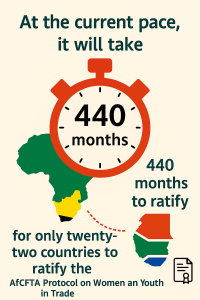
The arithmetic of current progress is stark and sobering. If the current observed pace equates to one State Party taking substantive ratification steps every 20 months, then reaching the required 22 deposits will take approximately 37 years, or 440 months. This projection places operationalisation of the Protocol in the 2060s and effectively means the Protocol might only be in effect one year before the stated endpoint of Agenda 2063. Such a timeline is incompatible with the urgency of economic inclusion for women and youth, as well as with the timelines African leaders have set for continental transformation.
Every year of delays is a year of lost contracts, forgone growth, and missed jobs for women and young entrepreneurs. The Protocol offers mechanisms to reduce the cost and risk of cross-border trade, to support value addition, to encourage formalisation and to protect traders from harassment. Delay in entry into force means delayed support for millions of micro and small enterprises that depend on timely access to markets and to digital and financial tools. It also undermines confidence in AfCFTA as an instrument of inclusive development and risks creating a perception that equity-focused measures are negotiable luxuries rather than essential complements to market opening.
The correct response requires immediate and coordinated action combined with political leadership, administrative support, and tangible incentives. South Africa must be recognised for its leadership, but it cannot be expected to carry the burden alone. Early ratifiers should form a visible compact that commits to a short and credible timeline for deposit. The African Union and the AfCFTA Secretariat must offer fast-track technical assistance that supplies model domestic legislation, parliamentary briefings and implementation toolkits for intellectual property, competition, digital trade and anti-harassment measures. Practical legal drafting and administrative roadmaps reduce procedural delays and lower the cost of domestic decision-making.
Financial institutions and development partners should align support with ratification milestones by offering small grants, de risking facilities and export readiness funding for women-led and youth-led enterprises that unlock when countries deposit instruments. Tying immediate, tangible benefits to ratification creates political incentives that change the calculus for hesitant governments. Civil society, business associations, and youth networks must mobilise to demand transparent timetables and present concrete business cases that show how the protocol delivers quick wins.
Transparency and public accountability are also essential. The African Union should host a simple dashboard that lists signatures, parliamentary steps and deposited instruments with named focal points. Such a tool converts opaque processes into visible milestones and allows constituencies to hold decision makers accountable. Likewise, pilot programs for intellectual property clinics, targeted trade finance windows, and digital trade access can be launched by willing states before their formal entry into force to demonstrate impact and build momentum.
South Africa’s ratification is courageous and catalytic. It proves that the protocol can be domesticated and that domestic reforms are manageable. The continent must now translate that leadership into a coordinated push that combines early ratification, technical assistance, finance, and public accountability so that the protocol does not languish for decades. Women and youth cannot be asked to wait until a distant future for measures intended for them. If Agenda 2063 is to be more than an aspiration, states must act now to convert commitments into ratifications and ratifications into programmes that deliver for women and youth without further delay.